


The Fireplace Collection
Jun
Sorry, Mantel. We Need to Talk.
You have had a good run. A few thousand years, give or take. But somewhere along the way the fireplace stopped being the beating heart of a room and turned into a shelf. A place to lean holiday cards and the occasional scented candle. The fire, the oldest and most magnetic thing we know how to put in a room, got framed like a family photo and hung on the wall as an afterthought.
We think fire deserves better. So does the wall.
Our new fireplace collection throws out the mantel entirely and replaces it with something we call a fascia. And no, that is not just a fancier word for the same thing. A mantel is an object you buy and stick onto a wall. A fascia is the wall, carved. It does not sit in front of the architecture, pretending to belong. It is the architecture, opened up to let the fire through.
The difference, in one sentence
A mantel does all its work at the edges. A fascia does its work everywhere.
Think about what a traditional surround actually is: a nicely detailed frame with a dead zone in the middle. All the craft lives in the profile of the shelf and the return of the legs, and the big flat expanse around the fire just sits there. A carved stone fascia flips that. The whole plane becomes the composition, and the opening for the flame is not a hole punched into a decorative object. It is the moment the surface finally resolves, like a piece of music landing on its home note.
Here is the part we love. Stone carved this way refuses to hold still. A flat marble surround looks the same at breakfast as it does at midnight. A carved surface does not. Low morning light drags long shadows out of every ridge and flute. Flat noon light calms the whole thing down. And firelight? Firelight makes it move. You are not buying a finished picture. You are commissioning a surface that performs a different show every few hours, for as long as the building stands.
Seven ways to open a wall
Every fascia starts as one of seven design directions, then gets adapted to your room’s proportions, palette, and mood. None of them are borrowed from the old ornament catalogue. Each one steals its ideas from the way stone actually gets its looks in the wild: wind, water, weather, time, and, in one case, the moon.
Emerge
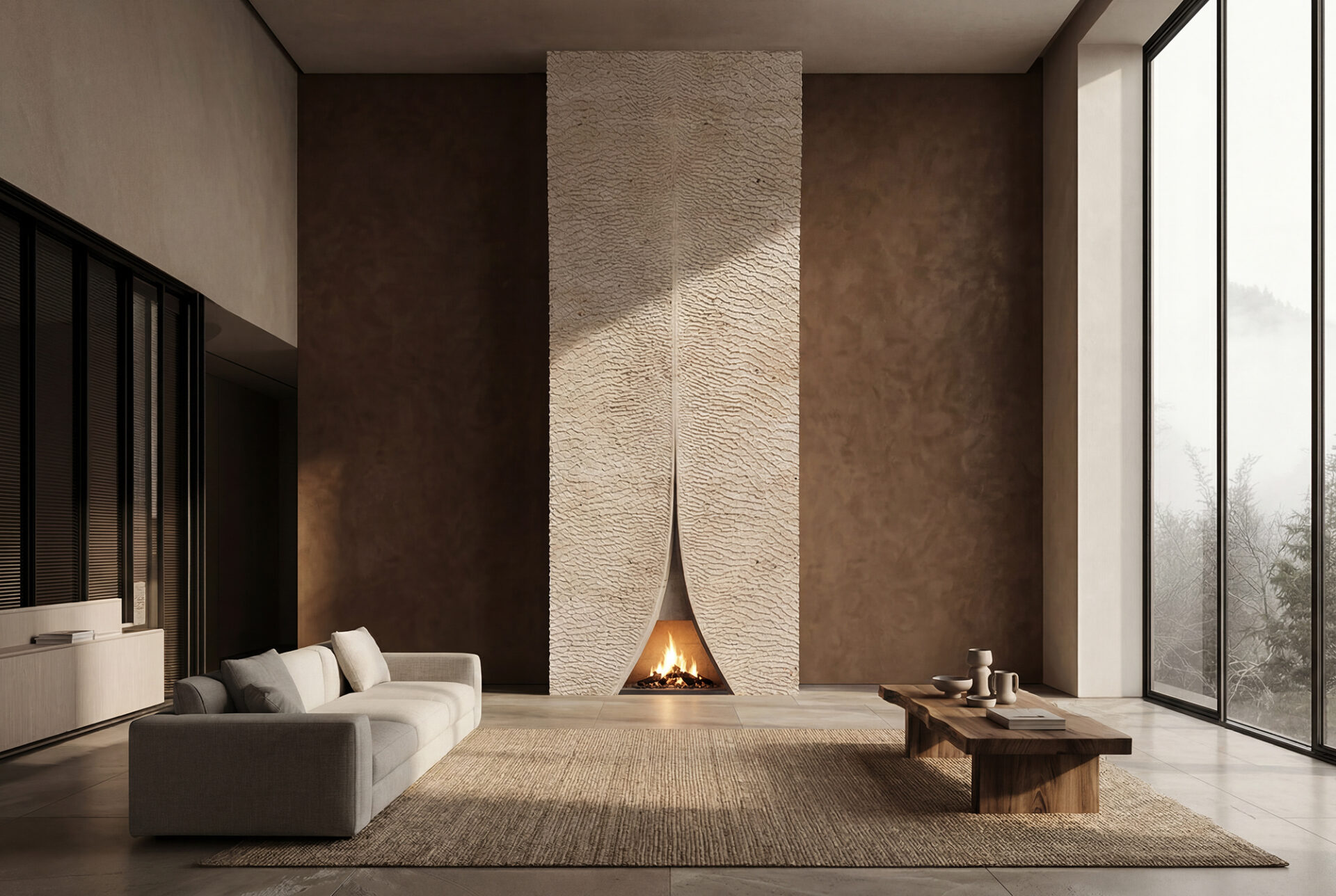
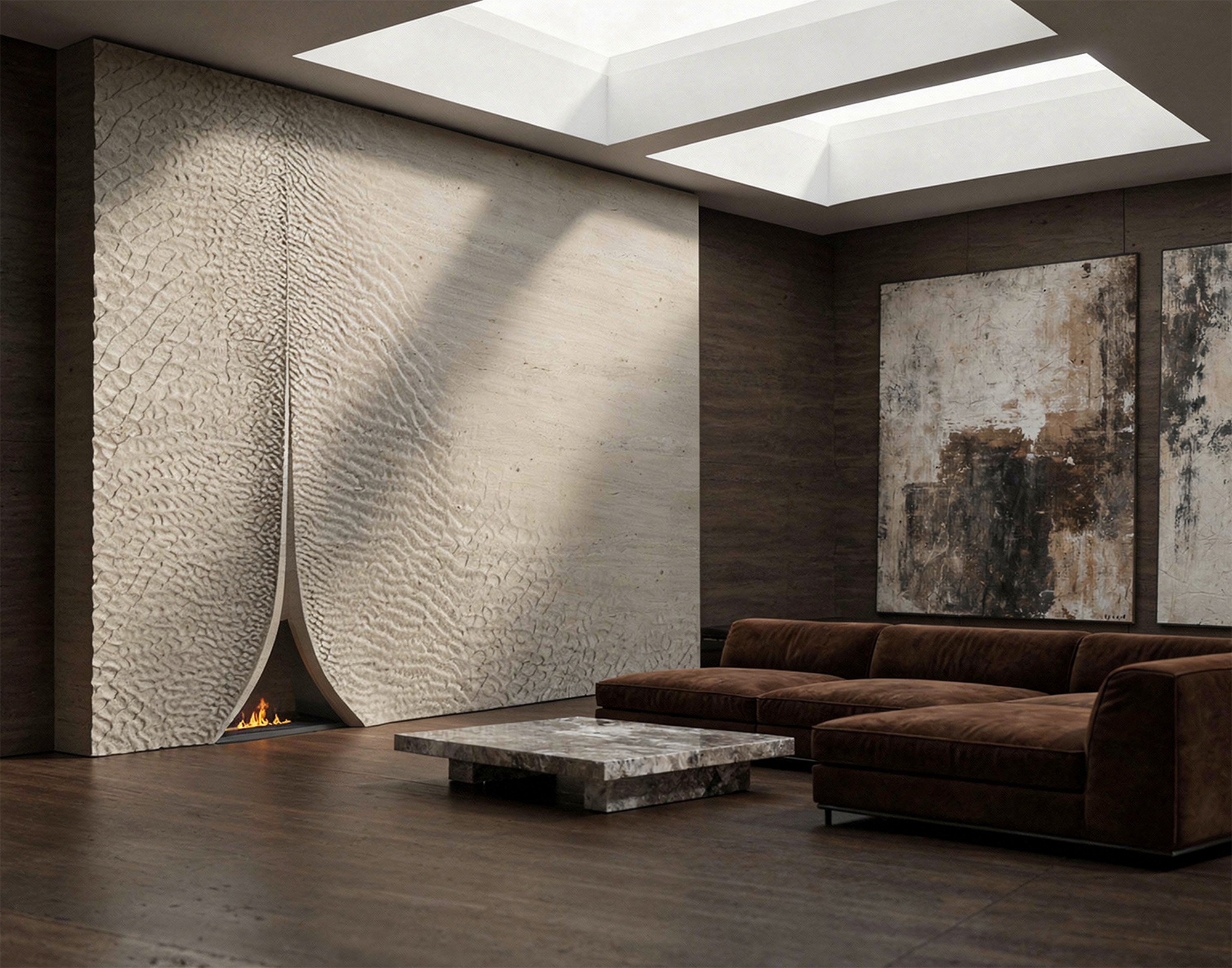
The desert one. Soft, rippling sand-dune texture, split down the middle by a vertical opening that looks like the stone has been gently peeled back toward the warmth. Tension and softness in the same breath.
Flow
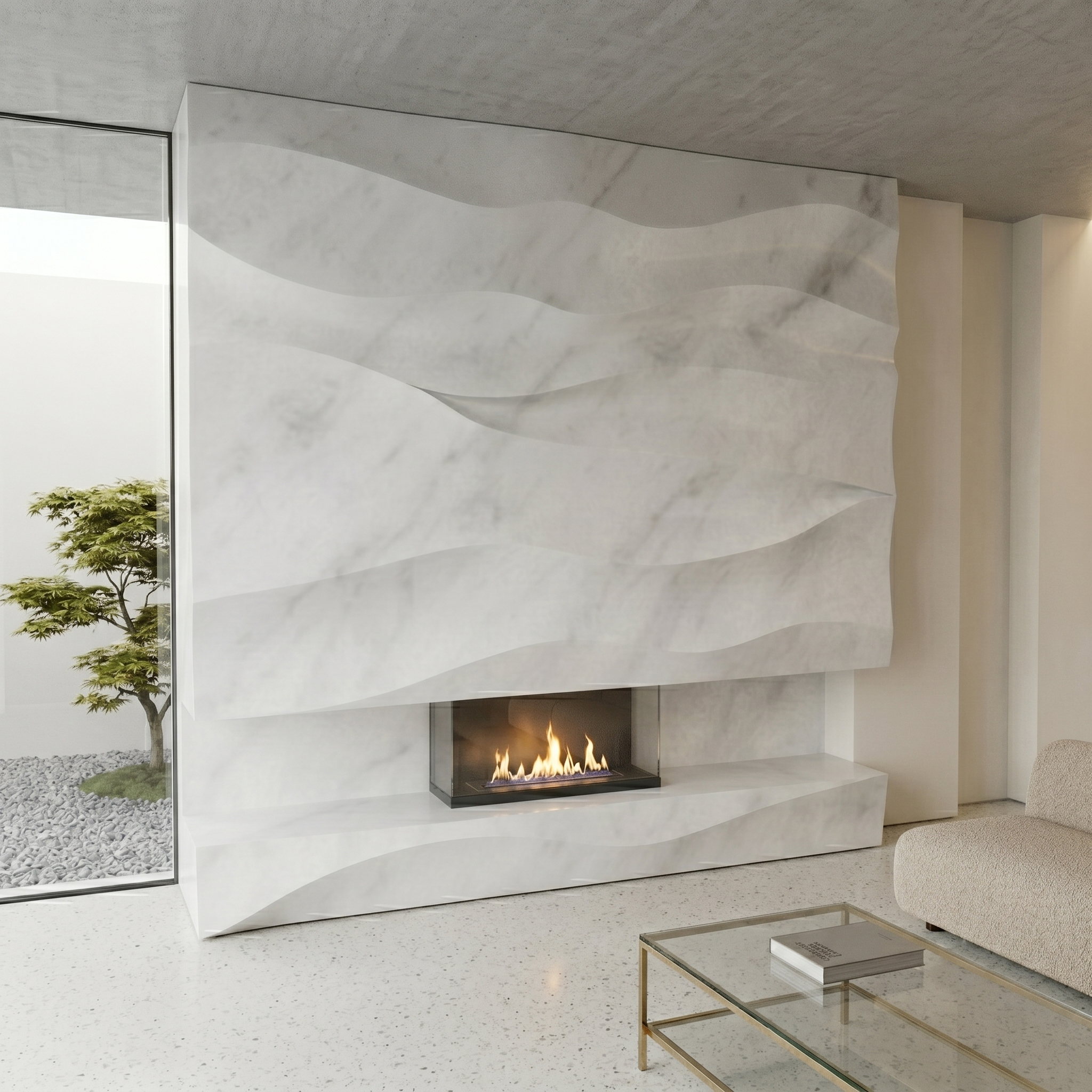
Emerge’s slower, more horizontal cousin. Undulating sedimentary bands run across the face, and the fire opening reads like a clean cut through rock strata, showing off the layers inside.
Cadence
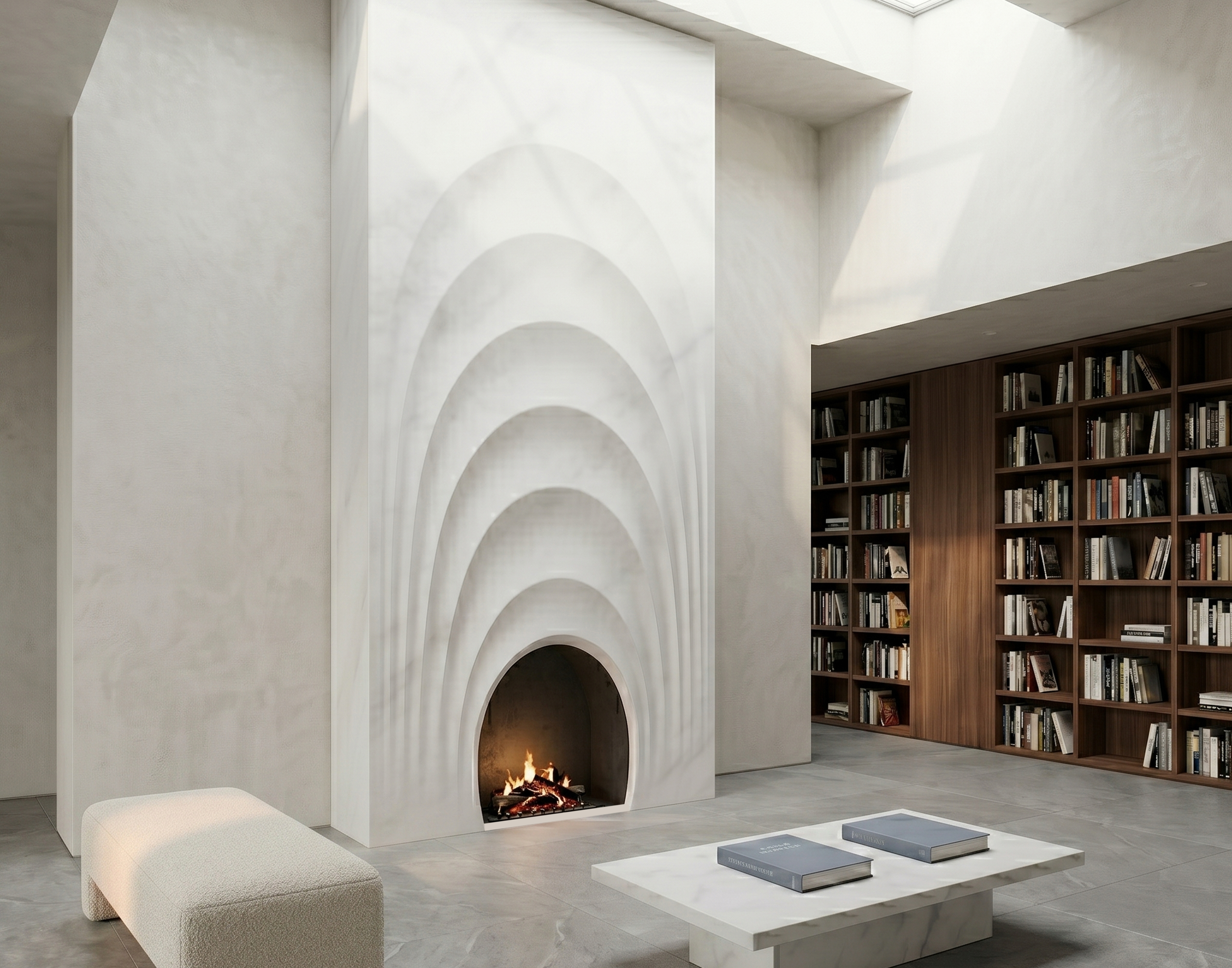
Leaves the landscape and walks into a cathedral. It borrows the logic of layered vaulting, carving stepped thresholds that pull your eye straight to the flame. Old idea, very new math.
Linea
The minimalist of the group. Take classical fluting, blow it up to an enormous scale, soften the edges, and you get big confident convex and concave waves that read as pure architecture instead of decoration.
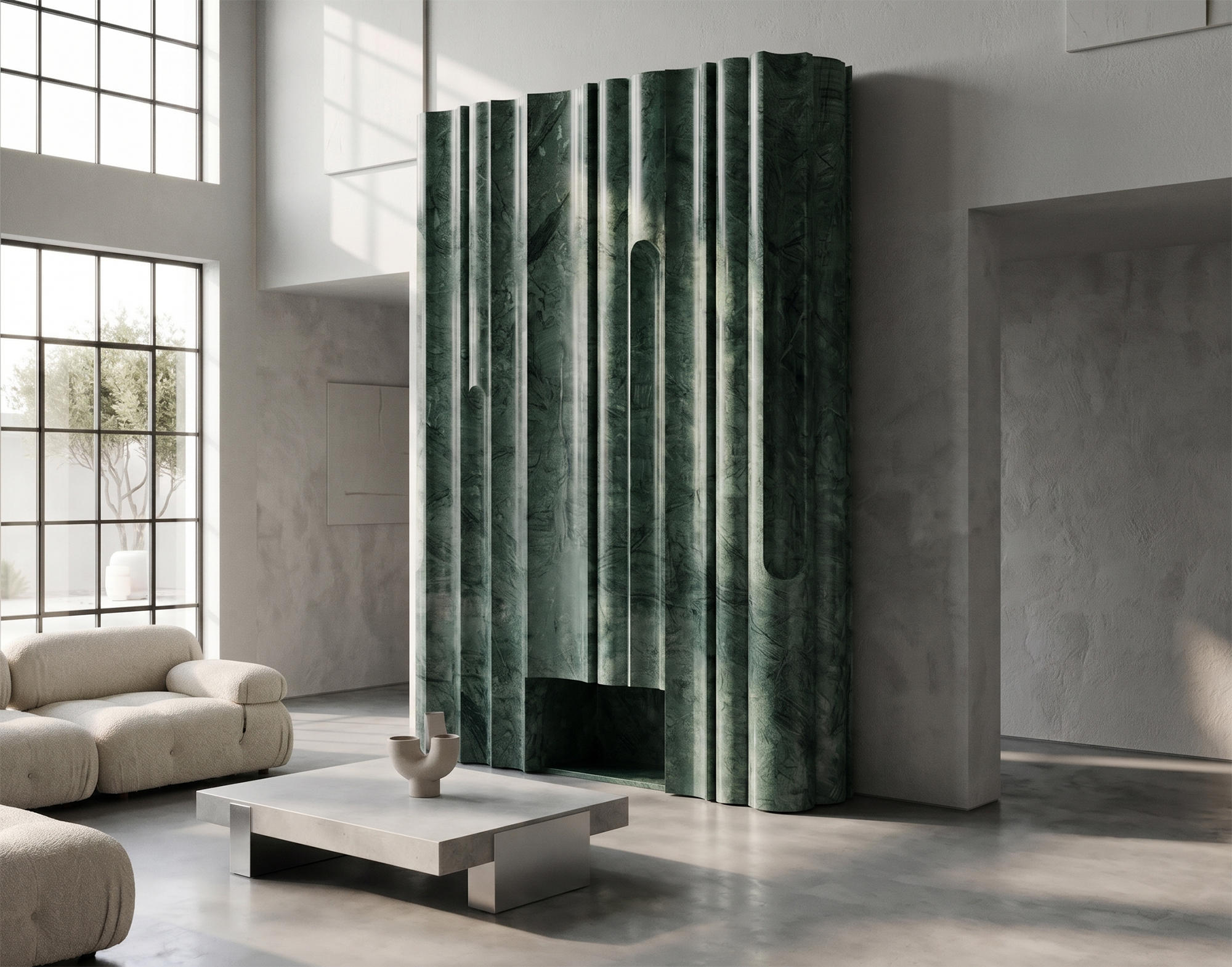
Cleft
Full cave. All about mass and void: a chunk of eroded cliff with a shelter-like opening carved around the fire and fissures that look genuinely weathered. Primal, protective, a little dramatic. In a good way.
Relic
Looks like you excavated it. Fragmented, covered in faded inscription-like markings, with the fire emerging from the field like a chamber someone just rediscovered. It carries a whole invented history on its face.
Lunar
The show-off, and we mean that lovingly. It takes the lunar terminator, that razor line between light and shadow on the moon, and sets smooth stone against cratered texture. The fire drops warmth into an otherwise cool, cosmic surface.
Seven directions, but really seven answers to one question: what do you want your fire to feel like? A dune. A ruin. A vault. A moon. Pick your mood.
Questions
Okay, but how does one of these actually happen?
Fair question, because you cannot exactly add a carved stone wall to your cart. It is a collaboration. You pick a direction, we help match it to the space. You send drawings, dimensions, and the material palette so we understand the room. We develop concept studies, refine the scale and depth together, coordinate closely with your fabricator, and then dry-lay the entire assembly at our facility before a single panel ships. We do not install, but we stay in the room, so to speak, right through execution so the design intent survives the job site. Start the conversation here.
Can I see a sample before committing?
We offer material swatches for color reference. Samples are made from stone remnants and are provided as a guide only. Natural variation in color, veining, and texture means the final material may differ. To see the specific stone that will be used in your project, request a sample from the production block when your order is placed. Request a swatch here.
What does something like this cost?
The range is wide because the work is. A sculptural mantel-scale surround starts in the tens of thousands. A single-height feature wall climbs into the mid-five and low-six figures. A full double-height statement piece, engineered and anchored into the structure, can run into the hundreds of thousands. What moves the number is exactly what you would guess: the stone, the size, how deep and complex the carving gets, whether it is seamless or modular, lighting, curves, and the logistics of getting it into the building. The more it behaves like architecture, the more it costs like architecture. We would rather tell you that up front.
Do you work directly with design teams?
Yes, and it is how most projects come together. We work with architects, interior designers, and specifiers from early concept through to delivery. Register for trade access here.
Do these work with gas fires as well as open fires?
Yes. Installation requirements vary by fire type and region so we recommend confirming with your installer ahead of ordering. Happy to help with technical questions along the way.
Start with a conversation.
mail@borrowedearthcollaborative.com